The Next 100 Million Americans Will Need a City.
The Plenary Urban Policy Summit · March 14–16, 2026 · Chicago, Illinois
McCormick Place Convention Center · Hosted by the Urban Land Institute
The Vacancy Paradox: Why Abundant Land Produces Housing Scarcity.
Across the Sun Belt, 73 metropolitan areas hold enough residentially-zoned land to house 40 million people — yet permitting rates in those same metros have declined 18 percent since 2021. The constraint is not acreage. It is the regulatory geometry layered atop it: minimum lot sizes, floor-area ratios, and parking mandates calibrated for a 1972 household that no longer exists.
Plenary's density modeling disaggregates each regulatory layer and projects the fiscal consequence of removing it. In Phoenix's 2031 general plan cycle, this analysis produced a $2.1 billion net positive shift in the city's 20-year infrastructure cost model — by eliminating the infrastructure extension premium embedded in sprawl.

FIG. 1 — Residential density study, Chicago South Side corridor, 2025
The Vacancy Paradox: Why Abundant Land Produces Housing Scarcity.
Across the Sun Belt, 73 metropolitan areas hold enough residentially-zoned land to house 40 million people — yet permitting rates in those same metros have declined 18 percent since 2021. The constraint is not acreage. It is the regulatory geometry layered atop it: minimum lot sizes, floor-area ratios, and parking mandates calibrated for a 1972 household that no longer exists.
Plenary's density modeling disaggregates each regulatory layer and projects the fiscal consequence of removing it. In Phoenix's 2031 general plan cycle, this analysis produced a $2.1 billion net positive shift in the city's 20-year infrastructure cost model — by eliminating the infrastructure extension premium embedded in sprawl.
Registration Open
March 14–16, 2026 · Chicago, Illinois
Rail Alignment Is a Land Use Decision Disguised as an Engineering Problem.
When a light-rail alignment shifts one block east, it does not merely reroute vehicles — it redraws the value capture geography of every parcel within a half-mile. $4.7 billion in federally-funded transit projects approved since 2022 have been sited without a corridor-level land use impact analysis. The result is predictable: station areas that generate surface parking instead of transit-oriented development, leaving the fare box to subsidize a land use pattern that undermines the line's ridership model.
This session presents Plenary's Transit Corridor Impact Index — a composite metric that fuses FTA ridership forecasts, parcel-level upzoning potential, and municipal fiscal capacity to score alignment options before the environmental review process closes the design window.

FIG. 2 — Light-rail alignment study, Milwaukee Connector EIS, 2024
Rail Alignment Is a Land Use Decision Disguised as an Engineering Problem.
When a light-rail alignment shifts one block east, it does not merely reroute vehicles — it redraws the value capture geography of every parcel within a half-mile. $4.7 billion in federally-funded transit projects approved since 2022 have been sited without a corridor-level land use impact analysis. The result is predictable: station areas that generate surface parking instead of transit-oriented development, leaving the fare box to subsidize a land use pattern that undermines the line's ridership model.
This session presents Plenary's Transit Corridor Impact Index — a composite metric that fuses FTA ridership forecasts, parcel-level upzoning potential, and municipal fiscal capacity to score alignment options before the environmental review process closes the design window.
Registration Open
March 14–16, 2026 · Chicago, Illinois
Flood Maps Are Infrastructure Plans. Most Cities Don't Treat Them That Way.
FEMA's updated 100-year flood maps now place 3.2 million additional parcels in Special Flood Hazard Areas compared to 2015 — parcels that collectively represent $890 billion in assessed value and anchor the tax base of 214 municipalities. The planning response in most jurisdictions has been reactive: revised setbacks, updated insurance requirements, and, eventually, a buyout program funded by CDBG-DR.
Plenary's Climate-Adjusted Fiscal Baseline replaces that reactive posture with a forward model: it projects the 30-year tax revenue trajectory of flood-exposed parcels under three climate scenarios, identifies the capital investment threshold at which managed retreat becomes fiscally superior to armoring, and produces the bond measure language to fund either path.
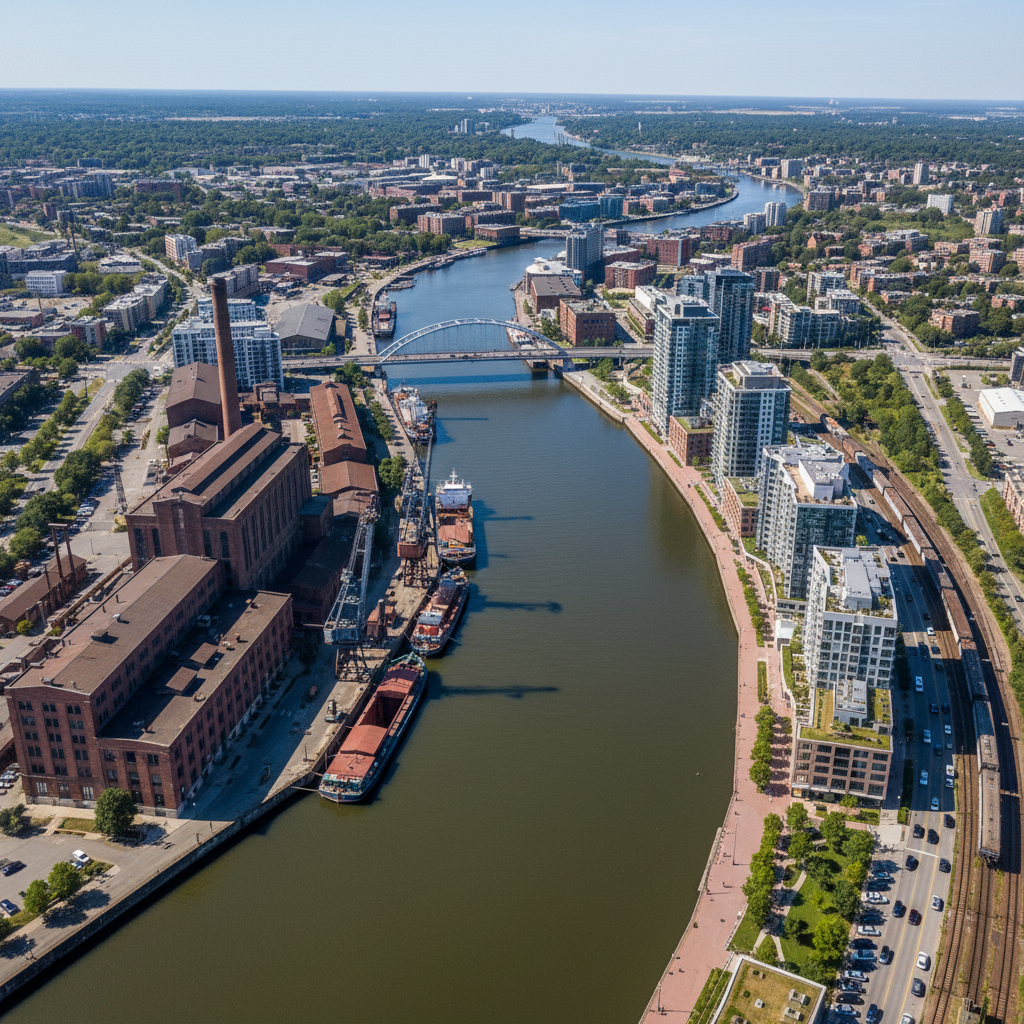
FIG. 3 — Waterfront rezoning study, Milwaukee River industrial corridor, 2025
Flood Maps Are Infrastructure Plans. Most Cities Don't Treat Them That Way.
FEMA's updated 100-year flood maps now place 3.2 million additional parcels in Special Flood Hazard Areas compared to 2015 — parcels that collectively represent $890 billion in assessed value and anchor the tax base of 214 municipalities. The planning response in most jurisdictions has been reactive: revised setbacks, updated insurance requirements, and, eventually, a buyout program funded by CDBG-DR.
Plenary's Climate-Adjusted Fiscal Baseline replaces that reactive posture with a forward model: it projects the 30-year tax revenue trajectory of flood-exposed parcels under three climate scenarios, identifies the capital investment threshold at which managed retreat becomes fiscally superior to armoring, and produces the bond measure language to fund either path.
Registration Open
March 14–16, 2026 · Chicago, Illinois
Secure Your Place at the Table.
Attendance is limited to 400 credentialed participants. Seats are allocated by agency type to ensure balanced representation across municipal, regional, and state jurisdictions.
Every registrant receives the full summit proceedings binder, access to the closed-session fiscal modeling workshop, and post-summit data access to Plenary's urban density projection models through December 31, 2026.